Monday, 12 July 2021

THE SHOES OF THE FISHERMAN


 My heart didn't exactly leap for joy when I saw that Michael Anderson was the director of "The Shoes of the Fisherman". At best, Anderson was a reasonable jobbing director whose main claim to fame was that he helmed that elephantine Oscar winner "Around the World in 80 Days", (and I felt I was there for everyone of them), as well as "The Bum Dusters", sorry "The Dam Busters", (you can tell I'm not a fan), and yet his fairly epic screen version of Morris West's novel actually works. Of course, with a more incisive and intelligent director it could have been something really special but even with Anderson at the controls it's a smart, hugely entertaining and ultimately moving picture with a good all-star cast all acquitting themselves admirably, (Anthony Quinn is excellent as the reluctant Pope and there's great work, too, from Vittorio De Sica, Leo McKern and especially Oskar Werner as various members of the clergy.

In case you don't know, the fisherman in question was Saint Peter, acknowledged to be the first pope and all subsequent popes are said to walk in the shoes of the fisherman. West's book is about the first Russian pope who does something very radical in order to both feed the world's poor and prevent World War Three. Of course, with a topic as topical and as controversial as this the book was a huge bestseller and the film version did make money. It's not a great film, (it's actually overly simplistic), and Anderson was never a subtle enough director to add depth though the scenes dealing with the Conclave of Cardinals and the election of the new pope have a documentary-like brilliance rare in a major feature film. Ultimately, this handsome looking film does exactly what it says on the tin and for that alone we should be more than thankful.

Monday, 5 July 2021

THE LIFE AND TIMES OF JUDGE ROY BEAN


 It may not be a late masterpiece but John Huston's movie "The Life and Times of Judge Roy Bean" isn't just one of his most underrated films but also one of his best. It's a picaresque western, (the title is a bit of a giveaway), with an even more laconic than usual Paul Newman in the title role with a supporting cast of 'guest stars' including Huston himself. It also introduced a young Victoria Principal, (Pam Ewing herself), and had Ava Gardner pop up as Lily Langtry.

Of course, Huston doesn't take any of it seriously. This is a blackly comic western, beautiful written by John Milius and with dialogue ripe for quoting, done as a series of set=pieces built around that terrific cast and, of course, it owes nothing to any other vision of Judge Roy Bean we may have seen, (Newman's about as far removed from Walter Brennan as it's possible to get). As an opening title says, this isn't the way it was but it's the way it should have been and it's a total delight.

Sunday, 4 July 2021

HELEN OF TROY


 Even the hardiest of Robert Wise fans tend to give this one a miss, (which isn't surprising if you have to sit through the overture), but it certainly isn't the worst of the widescreen epics that the studios churned out in the fifties in an attempt to drag audiences away from their television sets. "Helen of Troy" was another international co-production, filmed at Cinecitta and various locations in Italy and it certainly looked the part, (the battle scenes are particularly spectacular). Unfortunately, the script is a mish-mash of bad dialogue and well-known phrases, (at one point Helen actually says 'Beware of the Greeks bearing gifts'), mouthed in English by leads who couldn't really speak the language.

Rossana Podesta who played Helen is said to have learned her lines phonetically while Jacques Sernas, (Paris), has a voice clearly not emanating from the rest of him. Then there's a young Brigitte Bardot while various Spartans and Trojans include Cedric Hardwicke, Niall MacGinnis, Torin Thatcher, Harry Andrews, Ronald Lewis and Stanley Baker as Achilles the Heel. It's not much of a movie but as schoolboy adventure yarns go it's certainly entertaining and will brighten a dull afternoon any day.

Saturday, 3 July 2021

FINGERS


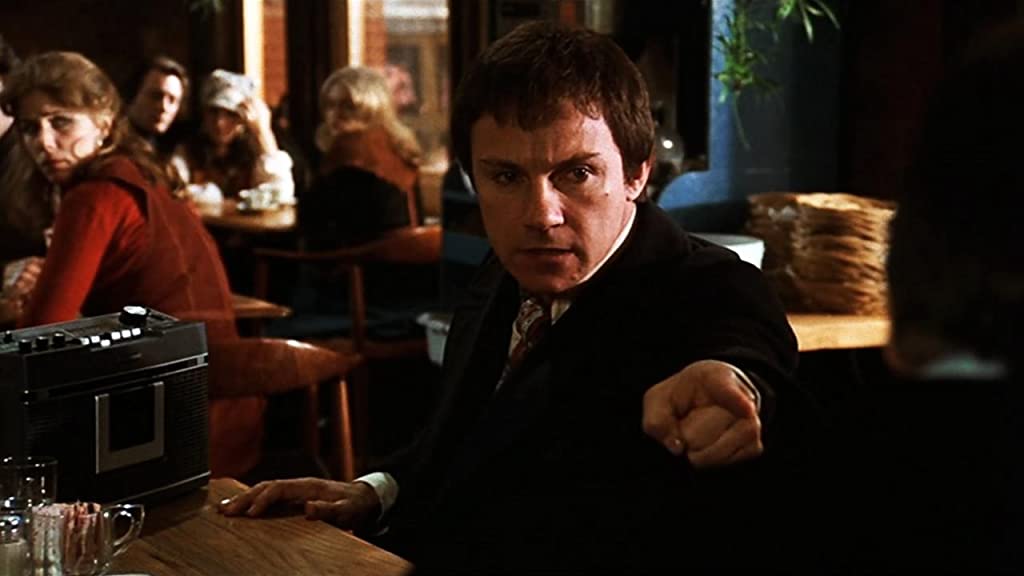
 "Fingers" is now generally regarded as James Toback's best film; Jacques Audiard clearly liked it enough to remake it as "The Beat that My Heart Skipped" and with Harvey Keitel in the lead it could sit quite comfortably on a double-bill with Scorsese's "Mean Streets". Keitel plays Jimmy 'Fingers', a gifted classical pianist with a passion for fifties and sixties pop tunes who, rather than using his fingers on the concert stage, acts as a sometimes vicious collector for his loan-shark father, (Michael V. Gazzo), and the movie comes over as a gangster flic with art-house pretentions.

A fairly young Keitel is terrific as always and he makes the psychotic musician a pretty scary figure while the supporting cast sometimes feels like a who's who of the casts of "The Godfather" movies, "The Sopranos" etc. But the film itself is much too loose for its own good and it meanders when it should be gripping us. Still, Toback makes good use of his New York locations and the whole thing is just weird enough to make an impression. It was never going to be 'popular' but it has cult movie written all over it.

Monday, 28 June 2021

THE INVISIBLE MAN


 H. G. Wells for the age of the Me Too Movement. Horror classics don't have to be fusty old period pieces with mist-shrouded castles and the occasional vampire bat though you might think from the credit titles that Leigh Whannell's "The Invisible Man" is going to be just that, (storm-tossed seas and what light from yonder window shines?). However, the light comes, not from a mist-shrouded castle, but an ultra-modern house that Elisabeth Moss' Cecilia is sharing with her abusive boyfriend. Yes, he's the invisible man of the title, quite literally as it turns out, and he's not prepared to let Moss get away from him.

This is a 21st century horror film built around a very real scenario, (a woman in an abusive relationship is stalked by her abuser only in this case she can't see him), and it's creepily alarming throughout. Moss, one of the best actresses on the planet, is terrific as the victim forced to fight back against an unseen assailant. It's a familiar role that can be traced back to the dawn of cinema but Moss gives it shadings other actresses might only dream of. Credit, too, to Whannell for handling what is fundamentally a ridiculous plot and making it feel both very real and very scary. At last a multiplex movie worth going out of your way to see.

Wednesday, 16 June 2021

DEVI


 Satyajit Ray made "Devi" in 1960. It was only his sixth film after completing his 'Apu Trilogy' and "The Music Room" but it's much less well-known and little seen today. It's also a masterpiece. The great Chhabi Biswas, (he of "The Music Room"), once again plays a rich, lonely old man who comes to believe his daughter-in-law is a reincarnation of the Goddess Kali. If the tale is a fanciful one it's grounded in the harsh realities of the India of the time, (it's set in the mid-nineteenth century), and its heart is a heart of darkness. Goddess or witch, the end result is the same; such superstition can only have a tragic outcome and this is one of Ray's finest tragedies. Working again with what was basically his stock company, Ray draws superb performances from his cast and like so much of his work, this is a great ensemble piece, superbly shot by Subrata Mitra and scored by Ali Akbar Khan. It's a film that cries out for restoration and rediscovery.

Thursday, 10 June 2021

MR. TOPAZE


 The only film that Peter Sellers ever directed was this comedy set in the Paris of the not-too-distant past and based on a Marcel Pagnol play that was filmed several times before, though this version, produced and written by Pierre Rouve, is chock full of well-known English character actors pretending they're French. In hindsight, it might feel like a strange choice for Sellers' directorial debut, and sole effort, but at least he's got the plum title role of "Mr. Topaze". a mild-mannered and scrupulously honest school master who loses his job because he won't give a rich man's son a better grade. As it happens, said rich man, (Herbert Lom), is also a crook who then employs Sellers to act as a 'front man' for his crooked business. 

It's shot in Cinemascope which doesn't really suit the material but on the plus side those character actors do throw themselves into the very old-fashioned material but it's certainly never as funny as it thinks it is. Sellers reputedly hated it, so much so that he tried to have all the prints bought up. It's not a bad film as such and at best it might be described as a curiosity and so out of step with other comedies of its time, it is, at least,  of more than passing interest but ultimately it's that supporting cast, (Leo McKern, Lom, Michael Gough, Martita Hunt, John Neville and a surprisingly good Nadia Gray), that saves it. It might have been better with a different director, (Sellers was clearly not up to the job). I suppose you could call it a cult movie and now that it's resurfaced maybe you should seek it out.

Wednesday, 19 May 2021

SAINT MAUD


 Horror movies come in all sorts of disguises that not everyone can recognise but then we all have our own horrors and our own definition of horror. Who can deny the horror of a lynching or being in a high-rise apartment as bombs fall on it from the sky but are movies about such things ever really thought of as 'horror' films. "Saint Maud" is a genuine horror movie and it's about the horror of not belonging, the horror of being so self-aware you actually go mad or insane and the horror of pain, both self-inflicted and inflicted on others; yes, there is a lot of horror in "Saint Maud".

Of course, there's a clue in the title; it's also about the horror of religion. 'Maud', (a truly terrific Morfydd Clark), is a young nurse and carer whose latest assignment is looking after Amanda, (an equally terrific Jennifer Ehle), a former dancer now confined to a wheelchair and close to death. Described early on in the film as being something of a Norma Desmond, Amanda is also something of a bitch who nevertheless finds herself somewhat sympathetically attracted to the waif-like Maud who is convinced God has put her on earth for a purpose and that purpose is to 'save' Amanda.

The opening shot is also something of a dead giveaway. You know from the moment you see her that Maud is no Saint Bernadette. She believes that to follow Christ you have to go the way of the cross; in other words you must take on board Christ's sufferings on earth and all the horrors they entailed, physically, if not quite in Maud's case at least, spiritually.

This extraordinary film is  brilliantly written and directed by Rose Glass and superbly shot by  Ben Fordesman and  unnervingly well scored by  Adam Janota Bzowski and its horrors work because they are fundamentally  real, (the more fantastical moments are clearly  figments of Maud's warped imagination). Maud sees the visitors to Amanda's sprawl of house on its hill as spawns of the devil that she must battle by whatever means she sees fit but unlike other 'possession' films this is totally grounded in a horrible reality; the house and its location, (the seaside resort of Scarborough in the North East of England), feel just like the kind of places where Maud's obsessiveness could fester and Maud herself is like an open wound. An astonishing debut for Glass and I can't wait to see what she does next.

Tuesday, 11 May 2021

PIERROT LE FOU


 Godard made "Pierrot Le Fou" in 1965 in widescreen and colour and he wanted it to look like a Hollywood film...except that he didn't really. From "Breathless" on, Godard made films that paid homage to the Hollywood of the Fifties but which subverted both the style and the content of what Hollywood was turning out. "Pierrot Le Fou" looks like it could have been made by Sirk or Minnelli on acid, visually as gorgeous as anything they had made but as crazy as a Samuel Fuller film and in case we miss that reference, who turns up at a boring party but Fuller himself.

Of course, being Godard, don't expect too much in the way of plot. Belmondo, now wearing a suit and living in a fancy bourgeoisie apartment, is Pierrot, (though he keeps insisting his name is Ferdinand), who walks out of that boring party and offers to drive the babysitter home, (she's Anna Karina, who else, and looking more stunning than ever), so they climb into his car and drive off together, (they had been lovers before), but there are guns involved, dead bodies and mysterious gangsters who seem to be after Karina.

None of this so-called plot matters, of course. This is a road-movie, (they drive from Paris to the South of France), that you might dream rather than experience or maybe it's just a parody of a road movie, an American thriller or a romance, (it's source is Lionel White's novel "Obsession"), and even if Belmondo and Karina weren't the lovers at the centre you'd still know you were watching a Godard film. Nobody, but nobody else, made movies like this in the Sixties and probably still don't and in its way this is just as influential as "Bonnie and Clyde", (come to think of it, this would make a great double-bill with Penn's masterpiece). A cineaste's movie to be sure and if it doesn't look quite as fresh today as it did back then, it's still essential.

Monday, 10 May 2021

RIO GRANDE


 A masterpiece. "Rio Grande" was the last in what became known as John Ford's Cavalry Trilogy and, of course, it's deeply sentimental in the very best Ford tradition. It's also one of the greatest westerns ever made. The plot may be flimsy but it's beautifully written by James Kevin McGuinness, superbly shot in black and white by the great Bert Glennon and has one of the best casts in the Ford canon. Wayne is still in charge as Lt. Col. Kirby Yorke, (it's a great performance), Maureen O'Hara is the long absent wife suddenly reunited with Wayne when their young son, (Claude Jarman Jr.), is posted to Wayne's command. Then there's the obligatory Ford stock company; Victor McLaglen, Ben Johnson, Harry Carey Jr., not to mention the Sons of the Pioneers bursting into song at every opportunity while the fairly broad comedy and the sentiment go beautifully hand-in-hand. There's also enough action to satisfy any western aficionado and the set pieces are splendid.

Friday, 7 May 2021

THE PAINTED BIRD


 Vaclav Marhoul's film of Jerzy Kosinski's novel "The Painted Bird" has already been described as one of the great films about the horrors of war and with a child at its centre has drawn comparisons with both "Ivan's Childhood" and "Come and See" but this terrible film, (terrible in its depiction of the terrors our young hero endures), surpasses them both in some ways though many will find it an almost unendurable watch. The setting is Eastern Europe, the period sometime during World War Two and The Boy, (nameless throughout and superbly played by young Petr Kotlar), is the child literally abandoned with nothing and forced to survive in the harshest of landscapes.

He's an infant Candide in the worst of all possible worlds and each encounter he makes is more terrible than the one before. Sometimes, and perhaps mercifully, these encounters are so extreme as to transcend reality. Surely nothing 'real' could be quite as awful as this and while we may be in the middle of the 20th century these people and this landscape is positively medieval. Shot in luminous black and white by Vladimir Smutny the film does indeed have a terrible beauty; this is one of the most visually arresting black and white films ever made and it is one of the most effective of horror films with a bleakness that is certainly overpowering.

A plethora of 'named' actors, (Udo Kier, Stellan Skarsgard, Harvey Keitel, Julian Sands, Barry Pepper), may be there to give the film international appeal but outside of a select art-house audience I can never seen this being 'popular'. There's only so much misery a person can take and, at close to three hours, the horrors of "The Painted Bird" seem never-ending.

IT FOLLOWS

 Already festooned with critical plaudits, "It Follows" is certainly a horror movie that's a cut above the rest though I'm...