Wednesday, 30 May 2018

THE DREAMED PATH


In the cinema of Angela Schanelec you cannot take your eyes off the screen for a second for fear of missing a vital piece of information. Schanelec doesn't make films that follow a logistical narrative path but rather she drip-feeds us a narrative that we must make sense of. There is sometimes a formal structure but often it's as if we have joined the characters in the middle of a conventional film rather than at the beginning and we leave them before the end as though her characters will live on after the film is over...or not; if a character's life is to come to an end it will happen off-screen. Either way, we the audience, will not be around to see what happens next. Of course, what happens 'in-between' wll most likely bore an audience seeking excitement or even something straightforward but if you are prepared to give yourself over to her style of film-making you may find yourself entranced.


Families are often at the heart of her films; particularly the dynamics between parents and children. Her latest film, "The Dreamed Path" begins with a couple meeting and seemingly striking up a relationship of sorts before swiftly moving on to embrace the boy's relationship with his ill mother and surly, blind father. The characters speak metronomically as if not quite in the same world that the rest of us inhabit or, as the title suggests, in a dream while 'stories' that appear to be developing lead nowhere. This is difficult, even challenging, cinema, in which even the passing of time is subverted as past and present intermingle and characters find themselves in places they ought not to be in, again as in a dream, (for once any synopsis handed out with the film is very welcome).

In the past I sometimes felt as if I were intruding on the privacy of Schanelec's characters but in "The Dreamed Path" they seem so cut off from reality that really isn't a consideration. It also may mean that this is her least accessible work and her least involving film. That said, it is also so much better than almost anything else you are likely to see this year; it simply shouldn't be missed.

Sunday, 27 May 2018

THE LOST CITY OF Z

Far from a conventional 'jungle adventure' James Gray's outstanding "The Lost City of Z" has more in common with the films of Werner Herzog than "The Mission". Bases on real events it's the story of explorer Percival Fawcett's search for the lost city of the title deep in the Bolivian jungle. It is a long, slow film more concerned with the psychology of its characters than their actions and it's very well played by Charlie Hunnam, (a revelation), Robert Pattinson and, in a major supporting turn, Angus MacFadyen. It's also stunningly shot by the great Darius Khondji and superbly written and directed by Gray, moving away here from the gritty confines of the American city where we usually find him. It wasn't really a commercial success but then in this day of action superheroes did anyone really think it would be. This is an art movie posing as an adventure epic and doing it very well indeed.


Wednesday, 16 May 2018

THE NOTHING FACTORY

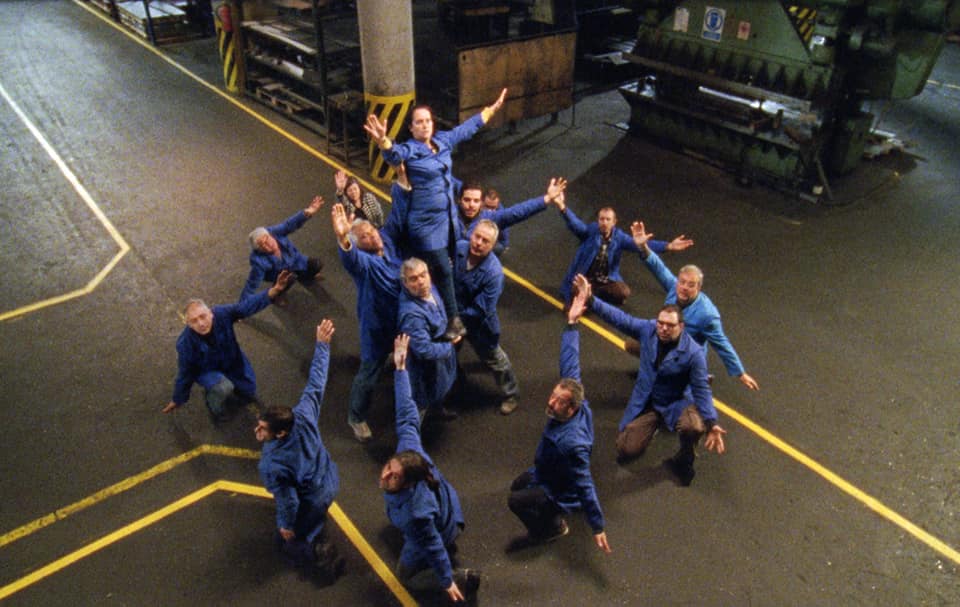
A true epic on the most unlikely of subjects - industrial relations or at least the rights of workers. There is definitely a touch of Miguel Gomes and his "Arabian Nights" trilogy about Pedro Pinho's glorious film about a group of factory workers doing what they can to save their factory and their jobs and if you think this is going to dry, dull and at three hours much too long, forget it. With his huge cast, almost all non-professionals, Pinho explores every aspect of their lives as well as opening up his film to look at, not just the state of the Portuguese economy but what he sees as the death of capitalism, using a number of cinematic styles so when the moment comes when the workers burst into a song and dance routine, it doesn't feel out of place. This is a funny, moving and really rather over-whelming film as good as anything you will see this year.


Wednesday, 9 May 2018

WHEN A WOMAN ASCENDS THE STAIRS

"The stairs in question are those of a bar in the red-light district of Tokyo and the woman who ascends them is Mama-San, the bar's chief hostess, but the stairs may just as well be those of a brothel for the girls who work these bars are basically prostitutes, (even in Japan in 1960 you could never be that explicit). Of all Japanese directors Mikio Naruse was the one most concerned with the plight of women in contemporary society and he brought to his tales of women fallen on hard times an almost Sirkian sensibility though even Sirk's melodramas stayed clear of the brothel. This may also be the most 'westernized' of all Naruse's films. We could be in the New Orleans of "Walk on the wild side" and even the credits of this film have a touch of the Saul Bass about them. (If only Dmytryk's film could have been this good). There is a naturalism to Naruse's film that American melodramas lack and it's this naturalism that lifts it out of being mere melodrama and into the realms of tragedy. Fundamentally, Mama-San is a woman who hates the life she has chosen but feels powerless to move on and Hideko Takamine, (from "Floating Clouds"), is superb in the role. Yet here is an actress and a director whose work never really traveled beyond Japan and even today Naruse trails in popular opinion well behind the likes of Ozu and Mizoguchi. Hopefully the release of this film in a DVD box set together with "Floating Clouds" and "Late Chrysanthemums" will rectify."

Thursday, 3 May 2018

THE SENSE OF AN ENDING

Something rare in British cinema these days; a highly intelligent, highly literate film based on a highly intelligent and literate book by Julian Barnes, (it won the Man Booker Prize).  It's one of those films in which people think everything out before acting on their feelings, sometimes shelving their feelings altogether in favour of a purely intellectual approach.  It's mostly told in flashbacks by Jim Broadbent's cynical old curmudgeon to his ex-wife Harriet Walter as he recounts the events of his past and his relationships with a potentially unstable girl, her family and his best friend.

Dramatically not a great deal happens and yet, as they say, all human life is here but it is so well written, acted and directed you cling to every word and it's a real pleasure to hear such good dialogue delivered as beautifully as it is here.  Broadbent hasn't been this good in years and Walters is wonderful as his ex-wife while Charlotte Rampling, in what is really just a cameo, is her usual outstanding self as the older version of Broadbent's first love. The younger players are also very fine; Billy Howle as the young Broadbent, Joe Alwyn as the friend, Downton's Michelle Dockery as a heavily pregnant daughter. It's also very touching and very funny; something of a real treat in fact.

YOU WERE NEVER REALLY HERE


I've seen Lynne Ramsay's "You Were Never Really Here" compared to both "Taxi Driver" and "Oldboy" though stylistically it doesn't resemble either of them which is par for the course with Ramsay. If the plot isn't all that far removed from that of "Taxi Driver" that's about as far as it goes as Joaquin Phoenix's traumatised veteran goes in search of a senator's daughter who appears to have been kidnapped by a gang of paedophiles. However, Ramsay doesn't make it easy for us. The film is incredibly visual but is virtually wordless with the narrative being split by flashbacks to Phoenix's past, particularly to a violent childhood, apparently at the hands of his father. 


It is an extremely violent picture though mercifully most of the violence happens off-screen. Needless to say, Phoenix is terrific and won the best actor award last year at Cannes as did Ramsay's screenplay, adapted from a book by Jonathan Ames. It wasn't a commercial success and consequently was ignored by Oscar. It was also Ramsay's first film in six years and was only her fourth feature in 18 years. Let's hope we don't have to wait so long for another film from this remarkable woman.

Tuesday, 1 May 2018

THE KILLING OF A SACRED DEER

The cinema of Yorgos Lanthimos is an acquired taste; luckily it's a taste that many cineastes have embraced wholeheartedly. He is clearly one of the great directors working today, utterly idiosyncratic and inhabiting his own very specific world. In other words, he doesn't make films that are easy to watch or 'realistic'; if his characters seem realistic they too inhabit worlds of their own.

He came to prominence with "Dogtooth", about a man who keeps his family locked within the comforts of a palatially modern Greek house. "The Lobster", his first film in English, was a dark fairytale that won him the Jury prize at Cannes and an Oscar nomination and now we have his masterpiece, "The Killing of a Sacred Deer" which combines elements of a genuinely disturbing horror film, a very black comedy and even Greek tragedy to awesome effect.


From the get-go it's virtually impossible to get a handle on which way the film is likely to go. His use of architecture, sweeping tracking shots and discordant music is sure to throw us off balance as is the metronomic dialogue and almost robotic acting. This time we are in, not a fairytale, but a fully fledged nightmare as surgeon Colin Farrel's ambiguous friendship with a surly 16 year old boy, (a terrific Barry Keoghan), goes not in the direction we anticipate but down a much darker and dangerous road altogether. Farrell's excellent though ultimately the film belongs to Nicole Kidman as his hard-nosed wife and to Keoghan as his nemesis. This is cinema at its most visceral and one of the best films of the year.

Friday, 27 April 2018

ACTING

The recent comments on my Facebook post on who should or should not have won the 1972 Best Actor Oscar, (I went with Brando and hopefully I will explain why), has prompted me to take a look at what constitutes good, or maybe bad, acting and to take a look at a few of those actors that are considered 'great' or the best. Acting seems to provoke a wealth of feeling with some of my Facebook friends coming to metaphorical blows on the subject.  Looking at those candidates for the Best Actor Oscar in 1972 I went, as did the Academy, with Brando's Don Corleone in THE GODFATHER, a performance many felt was nothing more than ham and yes, from quite early on in his career Brando had a propensity for ham.  Some, myself included, think he is still one of the all-time greats, a judgement I've reached based on a handful of performances, THE GODFATHER being just one, and I don't think there are too many people who will deny just how great he was at the start in films like A STREETCAR NAMED DESIRE, JULIUS CAESAR and ON THE WATERFRONT.  Unfortunately he got lazy early, coming to rely on mannerisms and funny voices. Sometimes it worked, (VIVA ZAPATA, THE YOUNG LIONS), but mostly it didn't, (dreadful as Napoleon in DESIREE, in pantomime mode in THE TEAHOUSE OF THE AUGUST MOON and just plain weird in MUTINY ON THE BOUNTY).

The older he got the fatter he got and sometimes I had to pinch myself to think the guy in THE APPALOOSA or THE COUNTESS FROM HONG KONG was the same man who played Terry Malloy. However, his 'comeback' performance in THE GODFATHER showed just how good he once was, Yes, he relied heavily on mannerisms and make-up here but to great effect in building the character from scratch.  Like his best early work it was often the gestures, the silences, his way with a single line, (the way he said 'the funny papers' in his final scene), that made this performance great and he was equally good the following year in his much more method-orientated performance in LAST TANGO IN PARIS.

The Method?  What's that all about? You could say it's the difference between what Laurence Olivier did and what Dustin Hoffman does.  If Olivier liked to 'act', Hoffman likes 'to be' yet both were capable of hamming, both were capable of bad acting. I never saw Olivier on stage, (I once queued for day tickets for a performance of THE DANCE OF DEATH but missed out), so I can only judge him on his screen work.  He was, of course, great in Shakespeare. His RICHARD III may be the greatest single performance on film and in the right role, (REBECCA, CARRIE, THE ENTERTAINER, on television in both A VOYAGE ROUND MY FATHER and in BRIDESHEAD REVISITED), he could be just as good but I am not a fan of his work in WUTHERING HEIGHTS in which I felt he was simply miscast as Heathcliffe and in old age he often reverted to some appalling mannerisms reaching a nadir in THE JAZZ SINGER.

Hoffman started at the top. Though too old for the part he was perfect as Benjamin Braddock in THE GRADUATE and two years later he disappeared totally into the character of Rizzo in MIDNIGHT COWBOY, a performance that showed he was as much a character actor as a method actor and subsequently he has been cast as much for his ability to play 'a role' as a variation of himself.  He has won two Oscars and for two very different parts, playing a 'character', adequately rather than brilliantly in my opinion in RAIN MAN and playing a living, breathing human being in KRAMER VS KRAMER.

The actors I've mentioned, of course, are ones most people rate as 'the best'. There are others that we all have opinions about, (Katherine Hepburn, Bette Davis, Spencer Tracy, Henry Fonda, James Stewart and the actress who may be the best to come from 'classic' Hollywood, Olivia De Havilland as well as the post-method school that includes Pacino and Jack Nicholson, not to mention Meryl with her 3 Oscars and 21 nominations), all capable of the best of acting and the worst. As I've said, acting isn't a science but an art; it is a job of work and we all have our bad days.  Of course, there are some actors I have always maintained are incapable of giving a bad performance,the ones I think of as the unsung heroes. For me, the greatest character actor will always be Ward Bond , who like Gene Hackman, is someone who couldn't give a bad performance if he tried, (and yet who is someone  totally ignored by Oscar), just as that old ham Maria Ouspenskaya could never give a good one. It is, you see, subjective. I am often surprised by the awards given to actors sometimes at the expense of others.  Recently I saw Andrew Garfield give one of the most phenomenal stage performances I have seen in 50 years of theatre-going, playing Prior Walter in both parts of ANGELS IN AMERICA yet his work was overlooked at the Oliviers in favour of Bryan Cranston in NETWORK. Admittedly I haven't seen Cranston's work but could it really have been better than Garfield's.


As I continue to single out my top 5 performances of the year in film I know I will incur the wrath of many people reading these posts as I choose which performance I would pick as the best, being castigated for leaving out a particular favourite of someone, (or even putting someone in the 'wrong' category; was Brando's performance in THE GODFATHER a lead or a supporting turn?).  I myself, like Joseph Corral and Craig Dudley, have acted on stage but unlike them never professionally. I was at one time a member of the '71 Players and, quite frankly, I was terrible. I could never seem to get into the part I was playing. I knew just how wooden I was and only came alive on occasions when I  committed the cardinal sin of improvising.  However, in real life I may be a very fine actor. As a Civil Servant I worked my way up the ladder fairly quickly, not because I was particularly good at my job or actually cared very much about what I was doing but because I was good at playing a role. I knew how to be the person people wanted me to be and I was good in interviews.  Now I hear you say, he's insincere but not at all. The role I was playing was that of myself; you get in me exactly what you see. Mr Shakespeare knew that all those centuries ago when he said 'All the world's a stage...' I shall leave you to reach your own conclusions on the rest of that sentence,
but not at all. The role I was playing was that of myself; you get in me exactly what you see. Mr Shakespeare knew that all those centuries ago when he said 'All the world's a stage...' I shall leave you to reach your own conclusions on the rest of that sentence,

Tuesday, 24 April 2018

4 'PERSONAL' FILMS

 1) VIRIDIANA. I have loved Bunuel's masterpiece since first seeing it in Birmingham's Electric Cinema, (currently the oldest working cinema in the UK), almost 50 years ago and it has stayed with me until the present day. Why? Well, I am a Catholic and I still 'practice' and this is a very Catholic film. Actually, most people would say it is the most 'Anti-Catholic' of films since finally piety is thrown over in favour of 'sin' and this is one of the few great films to tackle the subject of Catholic guilt. You might say all good Catholics are permanently guilty; it's drilled into us from birth so I can see myself somewhere up there on the screen, in the foreground or in the background, every time I see VIRIDIANA. Hopefully. unlike the heroine here, I will have my cake and eat it, too. 


2) THE QUIET MAN. I'm not just Catholic but an Irish Catholic and I love being Irish, as in born on the island of Ireland which is probably why I love THE QUIET MAN so much. This is the greatest (and the worst) of Irish films, a film that conjures up an Ireland that is basically mythical and the Ireland of our dreams. Of course, I have visit Cong where it was filmed and why not and of course it is one of the worst. It paints all us Irish men as priest-loving, women-beating, drunken IRA men...but then stop and think. Is this reality or a fantasy like STAR WARS. I will leave it up to you to decide.

3) SINGIN' IN THE RAIN. My Irish-Catholicism has nothing to do with this one. I fell in love with the cinema almost from the time I learned how to tie my own shoes and my father told me that I was born with a song in my heart, (though unlike him I have never been able to carry a tune) so why shouldn't I love SINGIN' IN THE RAIN and feel it is 'personal' to me since it is the greatest of all screen musicals and one of the few truly great films about the cinema.


4) BLOW UP. I have chosen this as my fourth most personal film because, while I have loved every frame of this masterpiece since first seeing it, (and making a pilgrimage to the film's famous London park), it was the favourite film of my late friend Mike who died in January. Mike was a true cineaste, a great blogger and a fabulous human being. I know I will never watch this film again without seeing him. Hopefully he is now in that big Art-House in the sky and smiling down on me.

Sunday, 15 April 2018

WAGONMASTER

This small John Ford western with no 'stars' but a cast of character actors is one of his masterpieces. It has a documentary-like feel to it as it traces the journey West of a party of Mormons and it may be the most authentic looking of all Ford's films, (it's on par with "The Sun Shines Bright" which he made a couple of years later).

There is a plot of sorts, (a group of bank robbers join the wagon train at one point), but the film's dramatic highlights are almost incidental. The splendid performances of Ford's stock company, (Ben Johnson, Harry Carey Jr, Ward Bond, Jane Darwell etc), adds considerably to the film's authenticity while the nearest the film gets to a full-bodied star performance is Joanne Dru's Denver. Dru was a much finer actress than she was ever given credit for as were Bond and Johnson, who at least was finally awarded with the recognition of an Oscar for his work in "The Last Picture Show". As he said himself, 'It couldn't have happened to a nicer fella'. Add Bert Glennon's superb location photography and you have a genuine piece of Americana that couldn't have some from anyone other than Ford. This is a film that truly honors America's pioneers and is full of sentiment and feeling.

Saturday, 14 April 2018

WHAT EVER HAPPENED TO BABY JANE?

One of the great movies about the movies, (and great movies about the movies aren't reverential, they bite the hand that feeds them), and the best of Aldrich's 'women's pictures'. Detractors see it as a misogynist load of horse manure about a couple of self-loathing sisters hauled up together in a decaying Hollywood mansion, a too-close-to-home study of the real life rivalry between stars Bette Davis and Joan Crawford or even as a veiled study of homosexual self-depreciation with the sisters as ageing drag queens. But these are the very things that make the picture great. It is precisely because it can be read in this way that makes it such a perversely enjoyable, subversive piece of work.


As the sisters, Davis and Crawford pull all the stops out and then some. What makes Crawford's performance great is that she is never sympathetic even when Davis is feeding her dead rat or quite literally kicking her when she's down, while Davis is simply astonishing. With her face painted like a hideous Kabuki mask and dressed up like a doll that's filled with maggots it's an unashamedly naked piece of acting, as revealing as her work in "All About Eve" and almost as good. Unfortunately the film's commercial success lead both actresses into a downward spiral of not dissimilar but considerably lack-lustre material. But this bitch-fest is the real McCoy.

THE BRIDE!

 Maggie Gyllenhaal's "The Bride!" wasn't a critical nor a commercial success and come awards time it's not likely to f...