Saturday, 4 August 2018

FRIENDLY PERSUASION

This piece of authentic homespun Americana is still one of a handful of truly great films made by its director William Wyler. It won the Palme d'Or at Cannes, something almost unheard of for an American film at the time. It's simplicity itself; a tale of Quakers during the American Civil War and very similiar in style and tone to Andrew McLaglen's "Shenandoah". Gary Cooper, (never better), is the peace-loving farmer, Dorothy McGuire, (equally good), is his wife and Anthony Perkins, (brilliant in only his second film and picking up an Oscar nomination), is the son who goes off to fight.


Wyler, who himself served in the Second World War, was too canny a director to make an outright anti-war film though the message of the picture is clear. He was also too good a director to fudge it. It may move at a quiet, almost stately pace while remaining one of his most overtly cinematic pictures. A huge hit in its day, it seems now to have all but disappeared.

Thursday, 2 August 2018

SCARRED HEARTS

Luminously photographed by Marius Panduru in the now unfashionable Academy ratio, Romanian director Radu Jude's superb new movie "Scarred Hearts" is based on the writings of Max Blecher and deals with the time he spent in a sanatorium on the Black Sea. The year is 1937 and Blecher's alter-ego is Emanuel, suffering from Pott's Disease, a form of TB. Though not an asylum, the hospital is something of a madhouse. Operations are performed with the minimum of anaesthetic, if any, and the doctors have no qualms in telling the largely manhandled patients exactly what's wrong with them and everything, including sex between the patients, seems to be permitted. Emanuel suffers more than most but bears it all stoically, even managing to fall in love with a former patient, and there is a good deal of humour in the film. Lucian Teodor Rus, making his screen debut, is excellent as Emanuel, even if he does spend most of the film on his back and Serban Pavlu is superb as his doctor. I'm sure for many people a two and a half hour film about illness might seem something of an endurance test but Jude makes even the grimmest passages seem somehow life-affirming. A wonderful picture.

Monday, 30 July 2018

WINTER KILLS

"Winter Kills" was a satire, and often a very funny one, on the Kenndy assassination, based on a novel by Richard Condon who also wrote "The Manchurian Candidate" and despite an all-star cast, mostly in cameo parts including an uncredited and silent Elizabeth Taylor, it was a gigantic flop both with the public and the critics, (though Vincent Canby thought it was the best American film since "Citizen Kane"). It's certainly not that but of all the conspiracy thrillers and paranoia pictures of the seventies it's the most fun.

Jeff Bridges is excellent as the dim-witted brother of the assassinated President running around trying to find out who organized the hit and John Huston is superb as his father, the real power behind the throne. Nice work, too, from Anthony Perkins and, in the Jack Ruby role, Eli Wallach. I'm not quite sure what audience writer/director William Richert had in mind when he made this but in the intervening years it has built up quite a considerable cult reputation and it certainly shouldn't be missed.

Sunday, 29 July 2018

HOME FROM THE HILL

If, like me, you consider Vincente Minnelli one of the all-time great directors then you have to accept that his melodramas are just as good as his musicals. In the fifties and sixties he made a series of heightened melodramas, grandly operatic in tone and shot largely in Cinemascope and colour, (the 1952 "The Bad and the Beautiful, which he made in black and white, is perhaps the most famous of his non-musicals but it's a piece of Hollywood hysteria I've never actually liked). If the subject matter of most of his films gravitated towards soap-opera, the style he applied and the look of these pictures was extraordinary.


Minnelli was fundamentally a designer and Cinemascope gave him the opportunity to use the screen as a vast canvas in which he could place his characters. A lot of these films are among the most visually stylish of their period. Of course, he was also blessed with very strong scripts and outstanding casts. He made "Home from the Hill" in 1960 and it's not as well-known as some of his other films. It doesn't deal with as 'controversial' a subject as homosexuality like "Tea and Sympathy", the same level of hysteria as "The Cobweb", the deep intensity of "Some Came Running" or the insider knowledge of the movie business of "Two Weeks in Another Town" but it remains a hugely exciting piece of cinema nevertheless.

It's a family drama and a surprisingly intimate one considering its two and a half hour running time. Robert Mitchum is the small-town patriarch who can't keep it in his pants and is living in a loveless and sexless marriage with Eleanor Parker. Their son is George Hamilton, initially a momma's boy but taken under his father's wing when he turns 17 and George Peppard is the young rough-neck who, it turns out, is Mitchum's illegitimate

son.

The very fine screenplay was by Irving Ravetch and Harriet Frank Jr from a novel by William Humphrey that veers from small-town soap opera to faux Greek tragedy complete with a Greek Chorus of gossipy old men and like almost everything Minnelli did he handles the interplay between his characters with the same brio as he handles the widescreen and his use of colour. It's also beautifully played by the entire cast with Peppard proving to be the revelation. It may be the least revived of his films but it's still unmissable if you do get the chance to see it.

IN A BETTER WORLD

One of the few Best Foreign Language film Oscar winners worthy of the prize Susanne Bier's IN A BETTER WORLD is a beautifully made, narratively complex and deeply moving work dealing with issues of family and relationships on a very broad canvas, (it moves between two continents). It's also one of the great films about childhood, (both boys are superb; William Johnk Nielsen as the violent and disturbed young Christian and Markus Rygaard as his more pacifist friend Elias giving two of the finest child performances I've ever seen). I suppose you could say that fundamentally it begins as a study about the relationship between fathers and sons and the friendship between boys before developing into a much darker study on the nature of violence both on a simple domestic level and on an international scale. It's a film that grips you from the start and never lets go. As Elias' parents, a Swedish doctor unable to deal with the ethical issues facing him both as a parent and a professional and his wife, also a doctor, Mikael Persbrandt and Trine Dyrholm are terrific. Certainly not an easy watch, I admit, but essential viewing nevertheless.

THEEB

For a time I actually thought this extraordinary film from the United Arab Emirates might win the Oscar for Best Foreign Film, (the Academy have always been partial to foreign films featuring children in leading roles), until I realised that the film's very simplicity, not to mention its 'exoticism', would almost certainly rule it out. Nevertheless it would have been a worthy winner, (it did win a BAFTA for outstanding debut by a British writer, director or producer).


It's set in the Ottoman province of Hijaz during the First World War and deals with a child's rite of passage as he embarks on a perilous journey, together with his older brother, to guide an English officer across the desert and through enemy territory. The boy, Theeb, is beautifully played by Jacir Eid Al Hwietat. Indeed this is one of the great performances by a child in the movies and this is one of the great films about childhood since everything is seen through Theeb's eyes. However, unlike a film made in the West, there is not a trace of sentimentality to be found, Visually superb it may be but this is a harsh picture of a harsh way of life and with this film alone, director Naji Abu Nowar has already earned his place in the annals of world cinema. See this at all costs.

CAUGHT

The least typical of Max Ophuls' masterpieces, "Caught" is a Women's Picture, written with a steely edge by Arthur Laurents. Barbara Bel Geddes is outstanding as the girl who marries money in the shape of Robert Ryan's sociopathic multi-millionaire, modelled so we are told on Howard Hughes, but he treats her with such contempt she runs away and gets a job as a receptionist to James Mason's struggling doctor. It's a triangle quite unlike other triangles in the movies of the time; there is a psychological depth at play here rare in a genre picture of its kind and both Mason and Ryan are superb while Ophuls' framing of the characters greatly enhances the relationships between them, (the distance between Ryan and Bel Geddes in his mansion, the close proximity between Mason and Bel Geddes in the office scenes).

In lesser hands this might have simply been novelettish but it isn't the superficiality of the material that interests Ophuls but how he can manipulate the material so the film is all of a piece. The least typical of Ophuls, I said; perhaps not. Shot after wonderful shot reveals this to be the work of one of cinema's great stylists and it really shouldn't be missed.

Saturday, 28 July 2018

THE BEST MAN

Dirty political in-fighting never really got more entertaining than in Franklin Schaffner's brilliant 1964 film of Gore Vidal's political comedy-drama THE BEST MAN. This is the one about the National Convention to choose a candidate to run for President. The front runners are nice, liberal Henry Fonda, (he's the Adlai Stevenson type), and rotten right-wing Cliff Robertson, who may look like a Kennedy but acts like Joe McCarthy, (and, of course, don't forget that Bobby Kennedy was once in the McCarthy camp). Each has dirt on the other; Robertson wants to release information that shows Fonda once had a nervous breakdown and would, therefore, be mentally incompetent to be president while Fonda's team has information that during the war, 'when there were no women around', Robertson was, euphemistically, a de-gen-er-ate, or to put it another way, he took his pleasures where he could find them, (why is it that it's always assumed straight men turn gay 'when there are no women around'?), but while Robertson has no scruples in blackmailing Fonda, Fonda is much too nice a guy to reciprocate.


We have to presume that Vidal, who also wrote the script, knows of what he speaks and Schaffner's film must indeed be accurate but no matter, it is still hugely enjoyable and is terrifically well acted. Of course, the role of the do-gooder intellectual politician fitted Fonda like a glove, (his performance here is almost a reprise of his role in ADVISE AND CONSENT). As his rival, Cliff Robertson was possibly never better; I honestly think his performance here eclipses his Oscar-winning role in CHARLY. Their respective wives are nicely played by Margaret Leighton and Edie Adams respectively while Shelley Berman is brilliant as the somewhat unreliable witness against Robertson and Lee Tracy is on terrific form, (and gaining an Oscar nomination), as a former president who just happens to be dying. Unfortunately it is not a film that is often revived but it is certainly one well worth seeking out. 

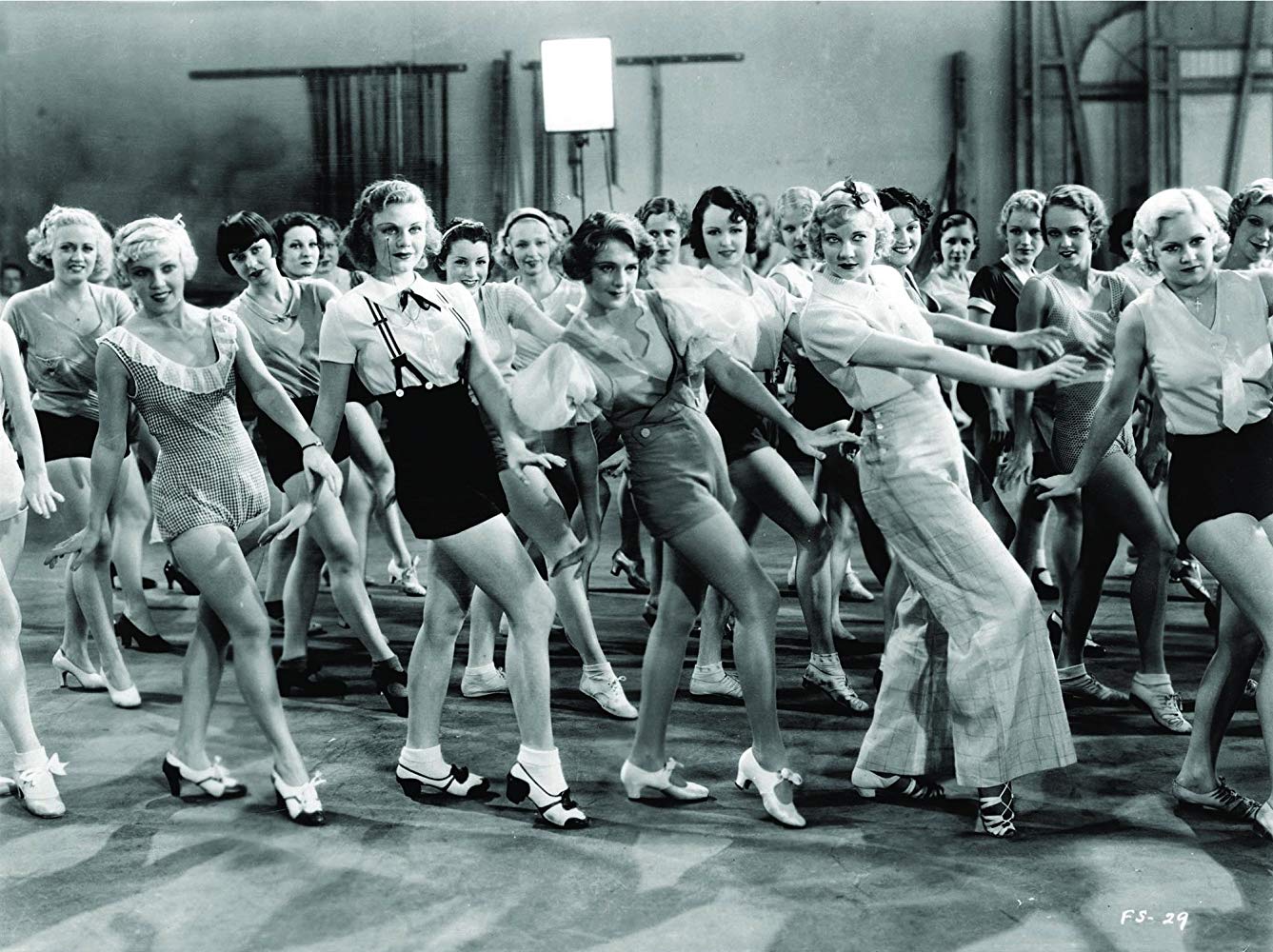
42ND STREET

What people tend to forget about "42nd Street" is that for a musical, certainly one as lauded as this one is, is that it's mostly devoid of musical numbers right up to the end when it lets loose with it's three big production numbers. Until then it could almost be seen as a documentary about putting on a show were it not for all the off-stage shenanigans between the players and, in their limited way, the cast are pretty near perfect.

Ruby Keeler still dances like a baby elephant but she has chutzpah to spare and acts like she really believes her own publicity. Dick Powell was always a charming juvenile, if a slightly mature one and Ginger Rogers displayed star quality even then and in too small a part. Warner Baxter may have cut the ham a tad thickly but he had a kind of wild, wide-eyed charisma nevertheless. Bebe Daniels and George Brent, in particular, are less convincing although the sight of Daniels hobbling in on crutches, ('Go out there and make me hate you'), is a camp delight. The production numbers of Busby Berkeley are a marvel in themselves. Lloyd Bacon is responsible for all the talky stuff that precedes them.

Thursday, 26 July 2018

FOR A LOST SOLDIER

It's unlikely that a movie like "For a Lost Soldier" would be made today. Some might say we live in more 'protective' times; others might say we live in more puritanical times. I have no intention of getting into arguments over the Me2 Movement or indeed about how cinema and the world at large has become more censorial on what we can see or say or do. "For a Lost Soldier" is by no means an explicit film but its theme is clear. It's about a 12 year old boy in war-time Holland who not only develops a friendship with an older Canadian soldier but also falls in love with him as well and, we are lead to believe, probably experiences something sexual with him, too. The boy grows up gay, (he is played in adult life by Jeroen Krabbe), though I would suggest he was always gay and was simply acting on his nature.


Since the film was made in 1992 the age of consent has gone down and the world in general is thankfully much more accepting of gay relationships in all forms though children are still protected in law from exploitation and rightly so, though someone seeing "For a Lost Soldier" might argue no exploitation takes place while others will argue that Walt, the soldier's relationship with the child is predatory since it is he who initiates the sexual element and may argue that the abuse is at least emotional. Some, on the other hand, will see him as innocent as the boy.

Of course, what the film basically is is a love story; a tale of first love, the difference being that both protagonists are male and one of them is a child. It was controversial when it was made and it's just as controversial now. It discusses issues that most people still find repugnant and it will always be a film that will have difficulty finding its audience. It isn't that well-made; director Roeland Kerbosch isn't the most proficient of film-makers and the acting is adequate at best but it remains a brave and challenging film and ultimately a very touching one. Unfortunately, times being what they are, it's now almost impossible to see.

Tuesday, 24 July 2018

A DATE FOR MAD MARY

"A Date for Mad Mary" is a small budget Irish comedy that arrived like a bolt from the blue into Irish cinemas last year. It never really did the business it deserved to and in a just world it would have been a world-wide indie hit, so if you missed it, seek it out as it's absolutely terrific. 'Mad' Mary McArdle, (star-in-the-making Seana Kerslake), has just been released from prison where she's been doing time for GBH, only to find she's to be Maid of Honor at her best friend Charlene's wedding. The problem is, she doesn't have a date to bring to the wedding.

This is the kind of feel-good movie we don't get enough of in our cinemas these days even if it has a dark core and a hard edge. It marked the feature debut of Darren Thornton, who co-wrote the picture with his brother Colin and for a fledgling director he handles his cast, young and old, male and female, with real aplomb; all the performances are outstanding. As Mary, Kerslake is never off the screen and she's superb but then everyone is. This is a funny, touching and up-lifting film and Thornton looks set to become the new Lenny Abrahamson.

IT FOLLOWS

 Already festooned with critical plaudits, "It Follows" is certainly a horror movie that's a cut above the rest though I'm...