Friday, 28 February 2020

EYES WIDE SHUT

It's largely accepted that Kubrick's "Eyes Wide Shut" failed because Kubrick died just after making it, the studio failed to market it properly etc. when the real reason, of course, is that it's really a pretty terrible picture. It may be brilliantly filmed in that typically cool Kubrick style and it often looks stunning but it's about a preposterously overrated subject (sex) with a very dull scenario that drags on for over two and a half hours and has a monstrously egotistical performance from the horribly miscast Tom Cruise as the rich New York doctor consumed by jealousy after his wife, (Nicole Kidman), tells him of an infidelity she's committed, if only in her mind, (it's that sort of picture). They are awful people, in a film full of awful people, though to be fair Kidman, in much too small a role, is superb. She's an actress who can make even the tiniest line reading seem significant and who can make an unpleasant woman feel painfully human, abilities Cruise seems unable to muster.

Of course, on a purely technical level it's brilliant. Kubrick recreates New York in an English studio and his prowling camera moves through his gigantic set as sensuously as ever but it's also his poorest and least interesting film. The dialogue is clunky, the supporting cast are cyphers and the central set-piece, which seems to last for most of the picture but in fact only amounts to about twenty minutes of screen-time, is probably the least erotic orgy in movie history. It's all meant to be mysterious, exotic and highly dangerous though the fact that it's based on Arthur Schnitzler's novel "Traumnovelle", first published in 1925, and now transposed to contemporary New York, might explain why it doesn't gel. In the end it's so odd it makes what happens in "The Shining" seem perfectly natural. No Kubrick film is completely negligible and this one does have its fans but it's a very acquired taste; a case of a sow's ear wrapped in a silk purse. On the plus side, the masks in the orgy sequence look terrific.


Wednesday, 26 February 2020

SNOWPIERCER

"Snowpiercer" is the Bong Joon Ho movie that many people have never heard of. He made it in English in 2013 and it's an ultraviolent dystopian sci-fi picture that takes place entirely on a train hurtling through a frozen landscape without stopping and standing in for the world at large, a world ruled by a single figurehead and divided by class. It's certainly imaginative and splendidly cast. Chris Evans, John Hurt, Jamie Bell, Octavia Spencer and Joon Ho regular Kang-ho Song are the good guys, in other words the lower classes condemned to the train's grim rear while Tilda Swinton and Ed Harris typify the ruling class, up front with the sacred engine and fundamentally it's about the revolt that occurs when those at the back decide to move to the front. If Joon Ho's Korean films are the ones for which he'll be remembered this is the one that might stand out as the cult favourite. It may be a Midnight Movie but it's one with heart, soul and chutzpah to spare.

Sunday, 23 February 2020

EL DORADO

A superlative Howard Hawks western and one of his most under-valued films perhaps because most critics saw it as something of a rehash of his masterpiece "Rio Bravo" with Robert Mitchum in the Dean Martin role, Arthur Hunnicutt in the Walter Brennan part and James Caan standing in for Ricky Nelson. There are certainly many similarities but there are classic sequences as well. Hawks' philosophy seems to be, 'if it ain't broke, don't fix it'.

This is an old-fashioned movie in the very best of the term somewhat out of sync with most American cinema of the period but there are few directors working in any genre who could master a sequence like the church shoot-out and its immediate aftermath in the saloon with such effectiveness and such an economy of style as Hawks. (The saloon sequence is lifted directly from "Rio Bravo", by the way, and some of the dialogue is identical). Not quite a masterpiece, then, but some kind of classic nevertheless.

SECRET CEREMONY

"Secret Ceremony" is Joseph Losey's weird and wonderful and largely forgotten masterpiece about two women bound together by nothing more than their illusions and interdependency; a mother in search of a dead daughter and a daughter in search of a dead mother. They are played magnificently by Elizabeth Taylor and Mia Farrow in this dark tale of mystery, imagination and madness. Of course, you need to suspend disbelief from the start since Losey's film has nothing to do with logic; reality doesn't enter into the equation, at least not until Robert Mitchum's abusive step-father intervenes.

Using the famous Debenham House in Holland Park as Farrow's family home, this is as much about place and objects as it is about people so that the house itself becomes the sixth character in the picture, (the others are Peggy Ashcroft and Pamela Browne as a couple of duplicitous aunts), while George Tabori's screenplay taken from Marco Denevi's prize-winning short story is sheer poetry. Of course, the film's mystical tone meant it wasn't a success but it's as good as anything in the Losey canon and is still one of the great 'London' pictures.

Friday, 21 February 2020

CAPE FEAR

When it first appeared in 1962 J. Lee Thompson's "Cape Fear" was largely dismissed as just another piece of pulp fiction despite having A-listers such as Gregory Peck and Robert Mitchum in the leads but it had its fans, amongst them Martin Scorsese who made a large-scale remake in 1991. Now, of course, Thompson's original is considered a classic and deservedly so. It's still pulp fiction and it's still nasty but it's a great piece of movie-making and a superb suspense picture.

Peck is the decent attorney who is being menaced by the vicious rapist he helped send to jail; it's as simple as that. What begins as purely psychological torture on the part of Mitchum's Max Cady turns increasingly more violent as the picture progresses, culminating in a brilliantly taut game of cat-and-mouse on the Cape Fear River. Peck's fine in his role but Mitchum's magnificent; it's a performance to set beside his Harry Powell in "Night of the Hunter". Add in Thompson's superlative direction, Sam Leavitt's brilliant black-and-while cinematography and a great Bernard Herrmann score and you have one of the best American films of its period and certainly one of the best thrillers of the sixties.

Thursday, 6 February 2020

BUNNY LAKE IS MISSING

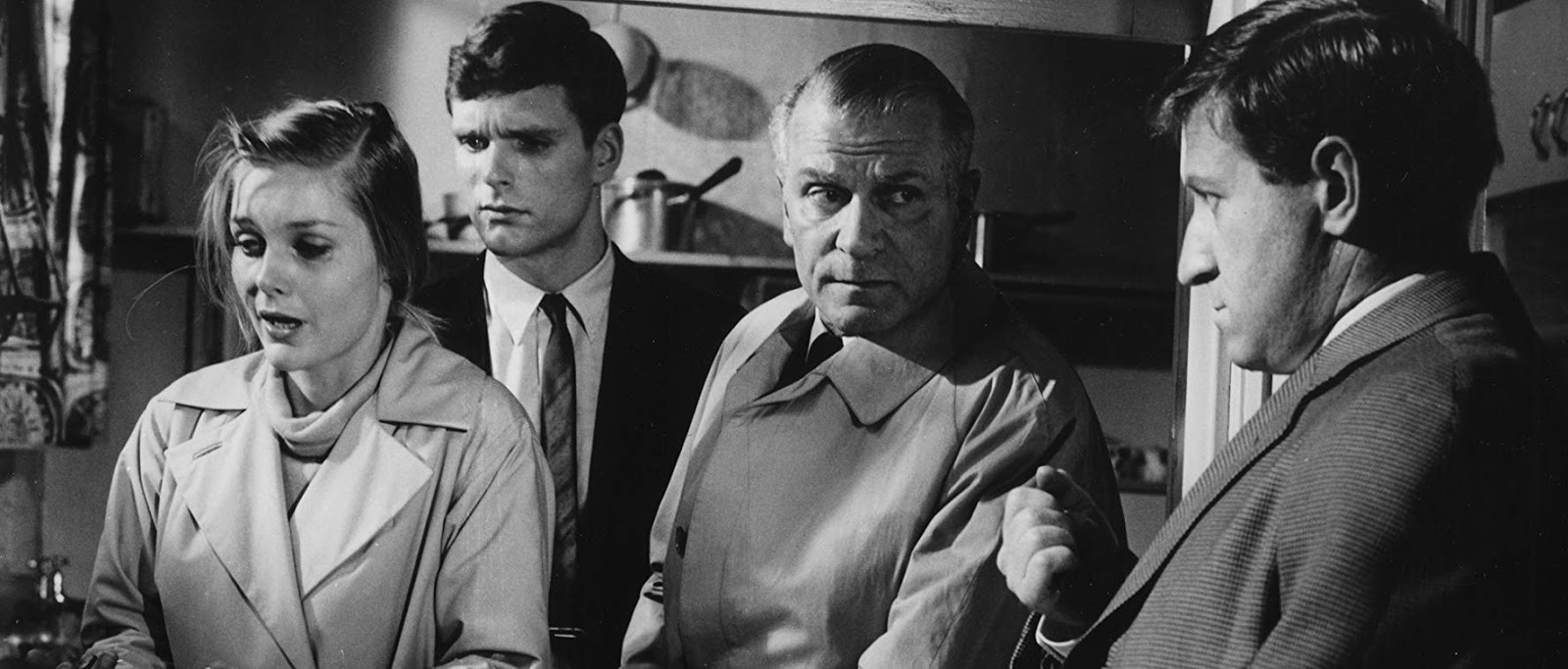
If "Bunny Lake Is Missing" isn't one of Otto Preminger's masterpieces it is, nevertheless, a terrifically entertaining psychological thriller, beautifully directed, written and acted. It's about the disappearance of a little girl in London; the conundrum is, did she exist in the first place. It was adapted, by the Mortimers, John and Penelope, from a novel by Evelyn Piper and it allows a number of very fine actors, as well as Keir Dullea, the opportunity to strut their stuff superbly. There's Laurence Olivier as a pragmatic policeman, that fine and underrated actress Carol Lynley as the distraught mother, Noel Coward and Martita Hunt as eccentrics and Dullea, surprisingly good, as Lynley's over-possessive brother while there are several very neat cameos from a host of well-known British character actors. There are enough clues scattered through the picture to figure it all out long before the somewhat protracted denouement yet even after several viewings the film has lost none of its appeal. Special mention should also be given to Denys Coop's superb black and white cinematography, (it's shot in Panavision), as well as Paul Glass' wonderfully atmospheric score.

Saturday, 1 February 2020

RICHARD JEWELL

In 1996 a bomb exploded at the Olympic Games in Atlanta. The FBI's prime suspect was Richard Jewell, the security guard who discovered the bomb and "Richard Jewell" is also the name of the superb film that Clint Eastwood has made about the case; it's one of his very best movies. Eastwood is almost ninety years old. Most men his age would be content to sit on their front porch and watch the world go by; Eastwood is a man who gets up off his ass and tries to do something about the state of the world he's living in. He cares. Politically conservative and a staunch Republican he is a great believer in 'doing the right thing', even if politically he and I wouldn't always agree on how to go about it. He's also a great director, arguably the best American director still working today.

Eastwood is, as I've said before, a classicist; there are few tricks, if any, in his work. He edits his films for the maximum effect each scene can deliver, not from flashy pyrotechnics but from good dialogue and fine acting and the acting in "Richard Jewell" is as fine as in any Eastwood film. No-one puts a foot wrong but Paul Walter Hauser in the title role, Sam Rockwell and Kathy Bates are outstanding.


Hauser is a character actor here given his chance at stardom which he grabs with both hands, (you might remember him as one of the racists in "Blackkklansman"). In lesser hands his character, though real, might have seemed just another cliche but Hauser makes him human while Rockwell as his lawyer and Bates as his mother lift parts that in lesser hands might have fallen flat. I know they are real people but these are traditional roles frequently seen in the movies of the past. Of course, a good deal of their success is down to Eastwood who handles his material with equal degrees of humour and sentiment. This is one of the best films of the year.

Wednesday, 29 January 2020

THE LIGHTHOUSE

Shot in black and white and in an aspect ratio of 1.19:1, giving us an almost square screen like the early silent movies and with really only a cast of two, Robert Eggers' "The Lighthouse" might appear to be either highly innovative or hugely pretentious or maybe even both. The setting is a lighthouse on a small, craggy island off New England, circa the 1890's. The only characters are the two lighthouse keepers, one young, (Robert Pattinson), and the other something of an old sea-dog, (Willem Dafoe), who seem to take an instant dislike to each other. The only way they have to pass the time is to work and to let their imaginations run away with them.

Eggers' movie has been described as a horror film but like his earlier "The Witch", it's far from a conventional horror film. Its demons are those of the mind rather than the spectres of the supernatural and its physical horrors are much more disturbing than its metaphysical imaginings and in the end it's up to its two players to sustain it. Pattinson has probably never been better and Defoe is simply magnificent. His is the most difficult role; his crusty old dictator could so easily have been nothing more than a cliché but Defoe gives his character shadings not immediately apparent in the script, as indeed does Pattinson.

Unfortunately, despite a highly unsettling score by Mark Korven and Jarin Blaschke's stunning cinematography boredom does set in before the climax, which I suppose was only to be expected. Eggers simply can't provide enough incidents of terror or indeed anything else to make us fully care about its protagonists. That said, there is enough here to ensure at least cult status and a considerable future for its director.

Sunday, 26 January 2020

FORD V FERRARI

The one thing that Hollywood is really good at is competition which you might find surprising since Hollywood is a far-arsed, monied town and you would think 'competing' wouldn't even enter into their vocabulary, (except, of course, during Awards Season), yet when Hollywood sets its mind to it and makes a film about competing, (think "Rocky", think "Aliens"), they are unbeatable. Their latest competitive movie is "Ford v Ferrari" and it's a contemporary classic in which every single piece fits perfectly into place just like the pieces of the classic cars on display. In this country it's called "Le Mans '66" so even if you didn't know it was about the car companies Ford and Ferrari you would still know what it's about and when it takes place.
Starting off with a superb screenplay from playwright Jez Butterworth, John-Henry Butterworth and Jason Keller. terrific performances from the likes of Christian Bale, Matt Damon, Jon Bernthal, Tracy Letts, Josh Lucas and Caitriona Balfe, brilliant editing, luminous photography all under the guiding hand of James Mangold this is a crowd-pleaser of the first magnitude and you don't even have to like cars to enjoy it, (though it helps). What you do have to like, however, is competing and who doesn't get an adrenalin rush from competing? It also helps if you like Christian Bale and Matt Damon. Bale's character may not be the most likable bloke in the world but this faultless actor is terrific in the role while Damon is fast becoming the go to actor of choice when it comes to playing craggy, steel-jawed heroes of a certain age, (surely his Oscar is just around the corner). The ending may be a tad predictable but the journey to it is one hell of a ride.


Saturday, 25 January 2020

THE WHITE SHEIK

Fellini undoubtedly made better films but his solo debut, "The White Sheik", is still one of his most enjoyable, (he had already co-directed "Lights of Variety" with Alberto Lattuada, perhaps because he was poking fun at something he knew very well, show-business and play-acting for the camera, and for Fellini show-business was always fun. Even when he was at his most 'serious' he could never quite take life seriously. Performers were everywhere; even his prostitutes were performers of a kind and here, The White Sheik of the title, is as flamboyant a performer as ever graced a Fellini film.

He's played by Alberto Sordi as a broad, narcissistic buffoon but Fellini showers him with affection. He's his own hero though the film's hero is actually the stuffy little bureaucrat, (beautifully played by Leopoldo Trieste), who has come to Rome on his honeymoon and whose wife our White Sheik sets out to seduce but who emerges from her encounters dimmer than a fading light bulb and purer than the driven snow. Here is comedy both broad and satirical. Watch out, too, for Giulietta Masina as a little streetwalker named Cabiria. Fame, for Mrs. Fellini, was just around the corner.

Wednesday, 22 January 2020

SHOPLIFTERS

The ghosts of Dickens, De Sica and Ozu hover over every frame of Hirokazu Koreeda's magnificent film "Shoplifters". This cross between "Oliver Twist" and "Shoeshine" but filmed in the style of Ozu's "Ohayo" is about a family of thieves in contemporary Tokyo who find a little, five-year-old girl abandoned by her abusive parents, take her in, shower her with affection and teach her to steal. They may be amoral and they may be lawbreakers but sometimes we find goodness in the strangest of places and in the least likely of people. What's worse, the film asks; stealing food and clothes or 'rescuing' a child, a crime society and the world at large views as the greater theft.

If the style of the film is neo-realist, the concept is purely humanist and, for once, Koreeda comes across as a Japanese Ken Loach and, like Loach, he draws extraordinarily naturalistic performances from his entire cast, (Miyu Sasuki, the little girl playing Yuri, is absolutely perfect), and there are great moments here, as good as any in recent cinema. Life, you see, is not black and white but full of all the colours of the rainbow if you just know where to look. Koreeda knows exactly where to look and this triumphant, beautiful and moving film is proof of that.

IT FOLLOWS

 Already festooned with critical plaudits, "It Follows" is certainly a horror movie that's a cut above the rest though I'm...