Wednesday, 19 September 2018

VICTORIA & ABDUL

Last year it was ethnicity that dominated the Oscars and this year it could well be longevity. I recently predicted that, at the age of 91, Harry Dean Stanton could be Oscar's oldest ever Best Actor and even now there is every chance he will be posthumously nominated while Dame Judi, a mere 82, should have no worries in being a sure-fire contender for her performance as Queen Victoria in "Victoria & Abdul". It's a part she has already played in "Mrs. Brown", (losing out to Helen Hunt in "It's As Good as it Gets"), and to be fair, this is something of a walk in the park for her.

We are told the movie is 'mostly' based on actual events but I think we have to take a lot of what we see with a pinch of salt. It's certainly an entertaining picture, if a little twee and whimsical at times, but there is also a little more heft to it than meets the eye. As written by Lee Hall and directed by Stephen Frears this is no mere sentimental, historical romp. It is, of course, the story of the Queen's friendship, in the years before her death, with her Indian servant Abdul Karim, (Ali Fazal, an actor new to me), which until recently was something kept very much under wraps and which was very much opposed to by the Prime Minister, her son the Prince of Wales and the entire royal household and Hall makes this another post-Brexit movie, (I have a feeling we are going to see a lot of post-Brexit movies in the next few years).


What we have here is a film about racism and about empire and it's quite as relevant today as it was back in Victoria's time. Not that you have to take it too seriously; there's a lot of low comedy on display and Frears has assembled an outstanding cast of British character actors. Eddie Izzard is an obnoxious future king, the late Tim Piggot-Smith is quite wonderful as the toadying head of the household, Michael Gambon is the befuddled Prime Minister and Paul Higgins practically walks off with the picture as the Queen's concerned doctor; concerned, not with her health, but with the number of Indians about the place. As a piece of film-making there is, naturally, a large dose of Masterpiece Theatre on display but that, in itself, isn't such a bad thing. "Victoria & Abdul" goes down a treat.

Tuesday, 18 September 2018

UNDER CAPRICORN

Largely derided in critical circles, Hitchcock's "Under Capricorn" is, in fact, one of his greatest films; on the one hand it's deeply romantic with an antecedent in "Rebecca" and on the other, a dark, psychological drama as good as anything he's done. It's a Victorian melodrama set in Australia, though it equally could have been set in the American Deep South during the Civil War. It's got a mansion, a distressed heroine, malevolent servants and a hero who used to be an ex-convict. If the Irish backstory is unconvincing, it's a small price to pay. As the once great lady who has taken to drink Ingrid Bergman is quite magnificent, (it's one of her greatest and most underrated performances), and as her husband, the stable-boy who has struck it rich, Joseph Cotten is very good indeed. The 'Mrs Danvers' role of the nasty housekeeper, (here called Milly), is brilliantly played by Margaret Leighton and even Michael Wilding acquits himself well as the visitor from Ireland. In some respects it's the least Hitchcockian of his films, (which may be why it isn't that highly thought of), but rather than dazzle us with tricks he just gets down to the business at hand. This is a good tale, superbly told and surely it 's time it was re-assessed.

THE STRANGE ONE

Jack Garfein made "The Strange One" in 1957. It was adapted by Calder Willingham from first his novel and then his play "End as a Man". Actually the title "The Strange One" doesn't really do it justice; a better, if somewhat declamatory, title might have been 'The Evil One' since its central protagonist, Jocko De Paris, is one of the most sadistic and warped anti-heroes in all of fiction. The setting is a military academy in the Deep South and Jocko is cock of the walk. He rules with a combination of charm and viciousness but it all goes belly-up for him when he targets a young cadet and his father, who happens to be an officer there. His scheme involves four other cadets whose fear of him he's counting on. It's a melodramatic scenario that culminates in a bravura, sustained passage of mounting hysteria but it's brilliant in the way that the best of Tennessee Williams or William Inge are brilliant. Willingham's dialogue has the ring of poetry to it and Garfein, whose first film this was, (he's only made one since), directs it superbly.

Of course, it would have been nothing were it not for its cast, many of whom were totally unknown at the time. Ben Gazzara may already have been a star on the New York stage, (he was Brick in "Cat on a Hot Tin Roof"), but was an unknown quantity in the movies, (it was also his first film). His performance as Jocko should have made him a much bigger star than he ever became and it remains a career-best performance. Those who fall under his spell include Pat Hingle, James Olson, Arthur Storch and George Peppard. They are all terrific; Peppard, also making his screen debut, shows real promise and Hingle in outstanding.


There's also one overtly gay character, (though the whole picture is suffused with homo-eroticism), a cadet who fancies himself a writer and who is obviously in love with Jocko. He's played by Paul Richards as a grotesque and flamboyant queen, part Truman Capote and part Gore Vidal. In any other film this character would be offensively out of place but here he's just one more poisonous plant in this insidious hothouse. The film wasn't successful and is almost impossible to see now, at least here in the UK but it's a masterpiece and one of the best American films of the fifties. Essential.

Monday, 17 September 2018

SMOKEY AND THE BANDIT

Long before Vin Diesel and "The Fast and the Furious" there was "Smokey and the Bandit". This road-movie was a monster hit and spawned several sequels and while no-one would claim it to be a great film it is a hell of a lot of fun and it put Burt Reynolds centre-stage with a star-making role as the titular Bandit. It might not have been the kind of part that would win Reynolds an Oscar but he is surprisingly good here, helped by a very decent script from James Lee Barrett, Charles Shyer and Alan Mandel.

The director was former stuntman Hal Needham who certainly knew his way around these backroads and highways and the terrific supporting cast included Sally (You Really Like Me) Fields, Jackie (Minnesota Fats) Gleason and Country singer Jerry Reed as well as Pat McCormick and Paul Williams. It may be reasonably minor in the grand scheme of things but it is very likeable.

PRIDE

Relying solely on his material, a terrific script by Stephen Beresford and a bevy of flawless performances, theatre director Matthew Warchus, (this is only his second film), has made in "Pride" the best feel-good gay movie since "Beautiful Thing" as well as a powerful piece of political manoeuvering in much the same vein as "Brassed Off". In 1984 a small group of lesbian and gay activists based in London decided to raise money for the Welsh miners during Britain's almost year long miner's strike. It was an uphill struggle; they had to battle the miner's homophobia for a start but their determination and their winning personalities won the day. As we know, the miners lost but out of this alliance a bond between the Trade Union movement and gay rights groups was forged that still exists to this day.


To enjoy "Pride", and it is a hugely enjoyable film, a knowledge of the events portrayed isn't any more necessary than being gay, a miner or even particularly left-wing in your beliefs. This is a humanist entertainment that is as funny as it is moving. It doesn't shy away from issues like homophobia and AIDS but its ultimate message is entirely positive. In a superb cast it's only fair to single out Bill Nighy, Imelda Staunton, Dominic West, (he's centre stage in one of the films two great musical interludes), Paddy Considine and Andrew Scott. Of the younger cast members George MacKay as a young activist coming to terms with his homosexuality, edges out his co-star and the film's ostensible male lead Ben Schnetzer but then almost everyone on screen makes their mark in what is a great ensemble. I can already see it seizing a slew of BAFTA nominations next year. Hopefully it will also make it across the Atlantic. British cinema has built up a good relationship with Oscar and there is no reason why "Pride" can't continue that relationship; it really is that good.

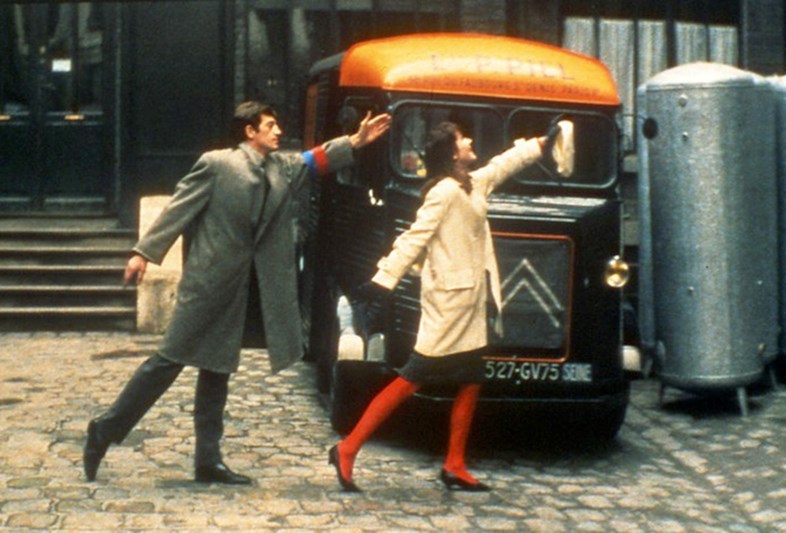
UNE FEMME EST UNE FEMME

Taking as his jumping off point the American musical-comedies of the 1950's, Godard then totally subverts them, following his debut masterpiece "Breathless" with something even more radical. "Une Femme est une Femme" is, on the one hand, Godard's most accessible film while being, at the same time, totally unconventional, even perversely so. It's like a home-movie in Cinemascope and colour and his use of colour and widescreen is up there with Minnelli and Sirk even as his script and his actors veer off into places his mentors would never have considered.

Anna Karina stars as the young stripper who wants to have a baby, either by Jean-Claude Brialy or Jean-Paul Belmondo, (she isn't too fussy), and she looks gorgeous. The camera loves her even if what she is doing up there on the screen might not quite approximate to 'acting' any more than what Godard is giving us could be called a typical film. This is the kind of movie that cemented his reputation and as many people hate it as love it. However, unlike many of his later films, (the out-and-out political ones), the last thing you could call this is boring.

SEANCE ON A WET AFTERNOON

This is probably Bryan Forbes' best film. It's an extremely taut, bleak and downbeat piece of work, the kind of thriller that truly merits the adjective 'clammy'. It is set in one of those London suburbs you really wouldn't want to live in, certainly not with a neighbour like Kim Stanley's demented medium who hatches a plot, (her weak-willed husband, played by Richard Attenborough, forces himself to go along with it), to kidnap a child then reveal the child's whereabouts to the police so she can achieve a kind of fame. But you know instantly that the woman is dangerously unstable and things can only go from very bad to much worse. Both Stanley, (much underused, at least so far as the cinema was concerned), and Attenborough give terrific performances and Forbes handles the unsettling material, (from a novel by Mark McShane), with considerable brio.

Sunday, 16 September 2018

BONNIE AND CLYDE

When Arthur Penn's Thirties-set gangster movie first appeared in 1967 it was like a breath of fresh air in the American cinema, (though to be fair, on hindsight, the American cinema in the previous few years, particularly in the Independent sector, wasn't doing too badly). Still, Penn's movie seemed to break new ground and not just in it's depiction of violence. It had a lyrical intensity that belonged more to the French New Wave, (and at one time Truffaut's name was associated with the project), and, in that it took back to the American cinema the trappings that the French had originally borrowed in films like "A Bout De SoufflĂ©" and "Shoot the Pianist", seemed to square the circle.

In the intervening years it has fallen somewhat out of fashion. It now almost seems quaintly old-fashioned, it's form more classically structured and narrativley driven than might first appeared. But there are virtues that have largely been overlooked. Like "The Graduate" which came out in the same year, it is a young person's film yet it burns with a fierce intelligence that is conspicuously absent from similar films today. I suppose you could say  the film has a pop-art sensibility, (a close-up of Faye Dunaway's face, lips burning bright red, could come from a Lichtenstein poster), and its cast seem unnaturally young, (only Beatty had  established a persona for himself at the time; the others had yet to establish a reputation), but they became stars because of it. (Gang members Parsons and Pollard didn't make the leap; they were character actors from the start). Arguably you could say Beatty, Dunaway, Hackman, Parsons and Pollard were never to better their work here. They may have equalled it but their performances were definitive.


Arthur Penn, too, was never to make another movie as good. The film's extraordinary critical and popular success gave Penn the freedom to tackle 'weightier' material, but "Little Big Man" and "Georgia's Friends" now seem misguided attempts at solemnity, while even his brilliant western "The Missouri Breaks" seems to succeed more for it's oddness rather than it's originality. Perhaps "Bonnie and Clyde" was a one-off though it did spawn an awful lot of break-neck thrillers and up-dated film-noirs, and was more responsible for the baby-boom in movies in the seventies than "Easy Rider" which followed it two years later. It remains a film ripe for reassessment.

THE GOOD, THE BAD AND THE UGLY

First of three masterpieces by the great Italian director Sergio Leone and the last of a trilogy of westerns which he made with Clint Eastwood, this marked a significant step-forward on the two previous films on which they had collaborated, ("A Fistful of Dollars" and "For a Few Dollars More"). The 'Once upon a time ...' movies would see Leone's films take on a much darker turn but although there is quite a lot of violence and death on display here, this is an almost jovial epic, (the humour comes from Leone's subversion of traditional western clichĂ©s). Almost every sequence feels, and looks, like a classic, (the climatic gunfight has the choreographed precision of a ballet), Tonino Delli Colli's widescreen cinematography is magnificent, and although dubbed, (very effectively), the English translation of the Italian script is first-class.

The plot is simplicity itself as Clint Eastwood, Eli Wallach and Lee Van Cleef search for some buried gold but the plot is only the thread of a much richer tapestry centred around events in the American Civil War. Stylistically and thematically this film would later influence Eastwood as a director. At a time when, in America, the western seemed long past it's sell-by date, in Europe Leone's homages single-handedly revitalised the genre paving the way for a whole new breed of post-modernist classics.

TO HAVE AND HAVE NOT

Howard Hawks made "To Have and Have Not" in 1944 and Bogie made it two years after he made "Casablanca", (his character and the plots of both films are very similar), and like "Casablanca"it's a masterpiece but like many masterpieces that came out of Hollywood during the studio years it's one almost by default. It's not deep or profound or particularly artistic but it's absolutely perfect; as good as movies are likely to get. The story goes that Hawks bet Ernest Hemingway that he could make a good film out of Hemingway's worst story and "To Have and Have Not" was what came up. There isn't too much of the original story left. The writers were Jules Furthman and William Faulkner and they expanded and greatly improved Hemingway's short story. In fact, "To Have and Have Not" has some of the best dialogue ever written and it's delivered by a dream cast.

This was the film that introduced a strapping 19 year old called Lauren Bacall to the world and introduced Bacall to Bogie. She's magnificent; she acts as if she was born into the role and maybe she was. Unfortunately she never got a part as good again but, at least, she got Bogie and kept him until he died a dozen or so years later, (you can see them falling in love). There's also Walter Brennan as the rummy; this, too, was probably his finest hour. The piano player is Hoagy Carmichael and the songs include "Am I blue" and "How little we know". It's similarity to "Casablanca" almost certainly did it no favours but in no way lessens it; it's greatness is definitely not in question.


Saturday, 15 September 2018

M

Films about child murderers are reasonably rare perhaps because the subject of child murder is so repugnant. The definitive movie about child murder, (Fritz Lang's "M"), kept the killings off-screen and concentrated instead on the psychopathology of the killer, (a superb Peter Lorre), whose final speech, ("I can't help myself..I have no control over what I do..."), brought the nature of his actions into sharp focus. Like many great movies, then, it seemed inconceivable that anyone would want to remake it, particularly in view of the subject matter, and yet in 1951 Seymour Nebenzal, who also produced the Lang version, decided to do just that.

The 1951 version of "M" was not a success. It dealt with a subject much too dark for an American audience and, furthermore, its director Joseph Losey was on the cusp of being black-listed and yet I think it is as much a masterpiece as the earlier German movie. The setting was moved from Berlin to Los Angeles, (superbly shot and making great use of LA locations by Ernest Laszlo). The plot remained very much the same with a few noticeable changes, (both the police and the criminal underworld are more 'enlightened' here), while the pivotal role of the murderer, seen for most of the picture as a mostly silent, shadowy figure was given to David Wayne, who up to that time was seen as a light comedy actor.


Casting Wayne may have been a risky strategy but it certainly paid off. There was something simple and unobtrusive about his presence, the ease with which he moved about children easily explainable as he seemed so childlike himself. When finally he is tracked down and brought to a large underground car-park for 'trial' his fear and panic are palpable and, like Lorre's, his long speech direct to camera is heart-breaking as well as a stunning example of the actor's art. If in the end there is the tiniest touch of melodrama introduced into the climax, it is forgivable in view of all that has gone before. This is an "M" for the McCarthy age, a genuinely frightening picture of an America where even the murder of a child isi viewed as collateral damage in a society where criminality is corporate. It's failure is both understandable and troubling; it is certainly Losey's best American film and one of the finest things he was ever to do. It is long overdue a re-release and a reassessment.

IT FOLLOWS

 Already festooned with critical plaudits, "It Follows" is certainly a horror movie that's a cut above the rest though I'm...