Sunday, 8 March 2020

THE SUGARLAND EXPRESS

"The Sugarland Express" was Steven Spielberg's first feature film and together with his earlier TV movie "Duel" and, I suppose, the later "Jaws", showed that he was more than capable of making outstanding films aimed at a grown-up audience. Even to this day, this is one of his finest films. It's based on a real incident that took place in Texas in 1969 although I'm sure Hal Barwood and Matthew Robbins' superb script embellished events somewhat as Goldie Hawn breaks husband William Atherton out of prison, kidnaps policeman Michael Sacks and heads off to the town of Sugarland to get back their baby son, pursued all the way by the police, (lead by Ben Johnson), and a convoy of interfering onlookers. Of course, it could only happen in America where freedom's just another word for nothing left to lose and where, fifty years later, Donald Trump is the President.

It's also a classic road movie; exciting, funny and ultimately tragic and is beautifully acted by everyone and in particular by Hawn who handles both the comedy and the tragedy perfectly. Of course, it's very much a film of its time; road movies were all the rage in the seventies but none were as smart as this and in place of his usual sentimentality Spielberg imbues it with real feeling and a terrific sense of place and he uses extras the way they should be used, as real people. Indeed this is one of the key films of its decade and is as good as it was on the day it was made.

Friday, 6 March 2020

LOTNA

After making his famous War Trilogy, ("A Generation", "Kanal" and "Ashes and Diamonds"), Andrzej Wajda made a very different kind of war film. You might describe "Lotna" as his 'War Horse' as it's about a great grey mare employed by the Polish Army during the Second World War. It's a visually impressive, (he shot it in a mixture of sepia and colour), near-epic account of men in battle with some scenes heavily influenced by Russian cinema, both from the period and from silent cinema. It may be no masterpiece but for some reason it's virtually been forgotten, a fate it definitely doesn't deserve. Four films in and Wajda was already proving to be a world-class director and there are moments here as fine as anything in his canon. Difficult to see now, it's worth making an effort to find.

THE TRUE HISTORY OF THE KELLY GANG

Justin Kurzel's films stand out for two reasons; they are visually superb and they are very violent. They can also be infuriatingly idiosyncratic, taking their literary sources and twisting them every which way. He mucked about with "Macbeth", making it more of a horror movie than any previous version and jettisoning Shakespeare along the way. Now he's gone to work on Peter Carey's Booker-Prize winning novel "The True History of the Kelly Gang", stripping it down to its bare bones. It's an acquired taste and not really the kind of thing to draw the crowds in on a Saturday night but once you get used to the pace and Kurzel's treatment it has a lot of offer.

Principal amongst its virtues are Ari Wegner's stunning cinematography and a very fine cast. Kelly is played, firstly as a child, by the excellent Orlando Schwerdt and later, as an adult, by the equally excellent George MacKay while Russell Crowe, (naturally), is the grizzled old outlaw who teaches young Ned his trade. Essie Davis, (of "The Babadook" fame), is excellent as Ned's mother while law and order are represented by Charlie Hunnam and Nicholas Hoult. The violence is still sickening and it often feels like a visual precis of Carey's novel rather than a proper adaptation but considering the lack of imagination in earlier versions of the story this feels very fresh indeed. Kurzel may well have a great film in him yet.

Thursday, 5 March 2020

CHARLIE BUBBLES

A few unwelcome scatological moments of surreal humour not withstanding, Albert Finney's only film as a director, "Charlie Bubbles", remains both a remarkable period piece and one of the most imaginative British films of the sixties, perhaps not the masterpiece I first thought it to be, (it was my best film of the year), but unmissable nevertheless. Finney made it in 1968, from an original screenplay by Shelagh Delaney, a time when the Kitchen Sink was no longer fashionable and a new kind of New Wave, typified by films like Nicolas Roeg and Donald Cammell's "Performance" and Richard Lester's "Petulia", was coming into play. This is certainly good enough to make you wish Finney had directed again.


He plays a working-class writer who has made it big, (he drives a Rolls and his books have been turned into films), and the film is set over the weekend he drives North and back to his roots with his unofficial secretary in tow, (a very good, if unlikely, Liza Minnelli), to see his nine year old son, (a first-rate Timothy Garland), who lives on a farm with Charlie's ex-wife, (a terrific Billie Whitelaw). Not much happens and at times Delaney's screenplay is a little too Pinteresque for its own good, but it's also a richly observant picture of Britain at a particular moment in time and is greatly enhanced by the superb cinematography of Peter Suschitzky.

Friday, 28 February 2020

EYES WIDE SHUT

It's largely accepted that Kubrick's "Eyes Wide Shut" failed because Kubrick died just after making it, the studio failed to market it properly etc. when the real reason, of course, is that it's really a pretty terrible picture. It may be brilliantly filmed in that typically cool Kubrick style and it often looks stunning but it's about a preposterously overrated subject (sex) with a very dull scenario that drags on for over two and a half hours and has a monstrously egotistical performance from the horribly miscast Tom Cruise as the rich New York doctor consumed by jealousy after his wife, (Nicole Kidman), tells him of an infidelity she's committed, if only in her mind, (it's that sort of picture). They are awful people, in a film full of awful people, though to be fair Kidman, in much too small a role, is superb. She's an actress who can make even the tiniest line reading seem significant and who can make an unpleasant woman feel painfully human, abilities Cruise seems unable to muster.

Of course, on a purely technical level it's brilliant. Kubrick recreates New York in an English studio and his prowling camera moves through his gigantic set as sensuously as ever but it's also his poorest and least interesting film. The dialogue is clunky, the supporting cast are cyphers and the central set-piece, which seems to last for most of the picture but in fact only amounts to about twenty minutes of screen-time, is probably the least erotic orgy in movie history. It's all meant to be mysterious, exotic and highly dangerous though the fact that it's based on Arthur Schnitzler's novel "Traumnovelle", first published in 1925, and now transposed to contemporary New York, might explain why it doesn't gel. In the end it's so odd it makes what happens in "The Shining" seem perfectly natural. No Kubrick film is completely negligible and this one does have its fans but it's a very acquired taste; a case of a sow's ear wrapped in a silk purse. On the plus side, the masks in the orgy sequence look terrific.


Wednesday, 26 February 2020

SNOWPIERCER

"Snowpiercer" is the Bong Joon Ho movie that many people have never heard of. He made it in English in 2013 and it's an ultraviolent dystopian sci-fi picture that takes place entirely on a train hurtling through a frozen landscape without stopping and standing in for the world at large, a world ruled by a single figurehead and divided by class. It's certainly imaginative and splendidly cast. Chris Evans, John Hurt, Jamie Bell, Octavia Spencer and Joon Ho regular Kang-ho Song are the good guys, in other words the lower classes condemned to the train's grim rear while Tilda Swinton and Ed Harris typify the ruling class, up front with the sacred engine and fundamentally it's about the revolt that occurs when those at the back decide to move to the front. If Joon Ho's Korean films are the ones for which he'll be remembered this is the one that might stand out as the cult favourite. It may be a Midnight Movie but it's one with heart, soul and chutzpah to spare.

Sunday, 23 February 2020

EL DORADO

A superlative Howard Hawks western and one of his most under-valued films perhaps because most critics saw it as something of a rehash of his masterpiece "Rio Bravo" with Robert Mitchum in the Dean Martin role, Arthur Hunnicutt in the Walter Brennan part and James Caan standing in for Ricky Nelson. There are certainly many similarities but there are classic sequences as well. Hawks' philosophy seems to be, 'if it ain't broke, don't fix it'.

This is an old-fashioned movie in the very best of the term somewhat out of sync with most American cinema of the period but there are few directors working in any genre who could master a sequence like the church shoot-out and its immediate aftermath in the saloon with such effectiveness and such an economy of style as Hawks. (The saloon sequence is lifted directly from "Rio Bravo", by the way, and some of the dialogue is identical). Not quite a masterpiece, then, but some kind of classic nevertheless.

SECRET CEREMONY

"Secret Ceremony" is Joseph Losey's weird and wonderful and largely forgotten masterpiece about two women bound together by nothing more than their illusions and interdependency; a mother in search of a dead daughter and a daughter in search of a dead mother. They are played magnificently by Elizabeth Taylor and Mia Farrow in this dark tale of mystery, imagination and madness. Of course, you need to suspend disbelief from the start since Losey's film has nothing to do with logic; reality doesn't enter into the equation, at least not until Robert Mitchum's abusive step-father intervenes.

Using the famous Debenham House in Holland Park as Farrow's family home, this is as much about place and objects as it is about people so that the house itself becomes the sixth character in the picture, (the others are Peggy Ashcroft and Pamela Browne as a couple of duplicitous aunts), while George Tabori's screenplay taken from Marco Denevi's prize-winning short story is sheer poetry. Of course, the film's mystical tone meant it wasn't a success but it's as good as anything in the Losey canon and is still one of the great 'London' pictures.

Friday, 21 February 2020

CAPE FEAR

When it first appeared in 1962 J. Lee Thompson's "Cape Fear" was largely dismissed as just another piece of pulp fiction despite having A-listers such as Gregory Peck and Robert Mitchum in the leads but it had its fans, amongst them Martin Scorsese who made a large-scale remake in 1991. Now, of course, Thompson's original is considered a classic and deservedly so. It's still pulp fiction and it's still nasty but it's a great piece of movie-making and a superb suspense picture.

Peck is the decent attorney who is being menaced by the vicious rapist he helped send to jail; it's as simple as that. What begins as purely psychological torture on the part of Mitchum's Max Cady turns increasingly more violent as the picture progresses, culminating in a brilliantly taut game of cat-and-mouse on the Cape Fear River. Peck's fine in his role but Mitchum's magnificent; it's a performance to set beside his Harry Powell in "Night of the Hunter". Add in Thompson's superlative direction, Sam Leavitt's brilliant black-and-while cinematography and a great Bernard Herrmann score and you have one of the best American films of its period and certainly one of the best thrillers of the sixties.

Thursday, 6 February 2020

BUNNY LAKE IS MISSING

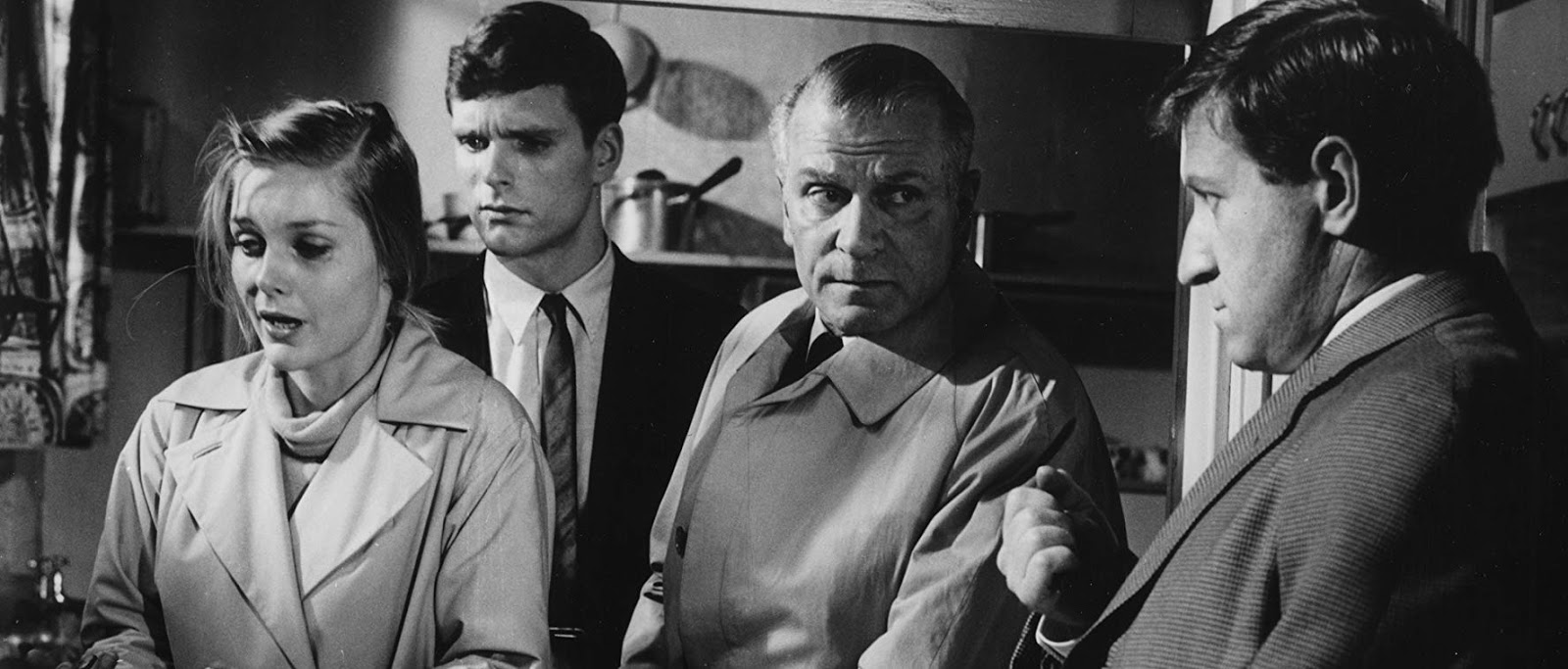
If "Bunny Lake Is Missing" isn't one of Otto Preminger's masterpieces it is, nevertheless, a terrifically entertaining psychological thriller, beautifully directed, written and acted. It's about the disappearance of a little girl in London; the conundrum is, did she exist in the first place. It was adapted, by the Mortimers, John and Penelope, from a novel by Evelyn Piper and it allows a number of very fine actors, as well as Keir Dullea, the opportunity to strut their stuff superbly. There's Laurence Olivier as a pragmatic policeman, that fine and underrated actress Carol Lynley as the distraught mother, Noel Coward and Martita Hunt as eccentrics and Dullea, surprisingly good, as Lynley's over-possessive brother while there are several very neat cameos from a host of well-known British character actors. There are enough clues scattered through the picture to figure it all out long before the somewhat protracted denouement yet even after several viewings the film has lost none of its appeal. Special mention should also be given to Denys Coop's superb black and white cinematography, (it's shot in Panavision), as well as Paul Glass' wonderfully atmospheric score.

Saturday, 1 February 2020

RICHARD JEWELL

In 1996 a bomb exploded at the Olympic Games in Atlanta. The FBI's prime suspect was Richard Jewell, the security guard who discovered the bomb and "Richard Jewell" is also the name of the superb film that Clint Eastwood has made about the case; it's one of his very best movies. Eastwood is almost ninety years old. Most men his age would be content to sit on their front porch and watch the world go by; Eastwood is a man who gets up off his ass and tries to do something about the state of the world he's living in. He cares. Politically conservative and a staunch Republican he is a great believer in 'doing the right thing', even if politically he and I wouldn't always agree on how to go about it. He's also a great director, arguably the best American director still working today.

Eastwood is, as I've said before, a classicist; there are few tricks, if any, in his work. He edits his films for the maximum effect each scene can deliver, not from flashy pyrotechnics but from good dialogue and fine acting and the acting in "Richard Jewell" is as fine as in any Eastwood film. No-one puts a foot wrong but Paul Walter Hauser in the title role, Sam Rockwell and Kathy Bates are outstanding.


Hauser is a character actor here given his chance at stardom which he grabs with both hands, (you might remember him as one of the racists in "Blackkklansman"). In lesser hands his character, though real, might have seemed just another cliche but Hauser makes him human while Rockwell as his lawyer and Bates as his mother lift parts that in lesser hands might have fallen flat. I know they are real people but these are traditional roles frequently seen in the movies of the past. Of course, a good deal of their success is down to Eastwood who handles his material with equal degrees of humour and sentiment. This is one of the best films of the year.

CELINE AND JULIE GO BOATING

 Since it's currently sitting in joint 78th place in the 2022 Sight and Sound poll of the greatest films ever made there must be enough ...